SmallHD 1703 HDR Calibration Overview
The SmallHD 1703 HDR is a 17-inch professional production monitor from SmallHD, designed for on-set use where a larger viewing image is needed for directors, DPs, and video village setups. It features a 1920×1080 IPS panel with around 1000 nits brightness, making it daylight-viewable.
Below is an overview of the display's performance before and
after professional SmallHD 1703 HDR calibration.
A 3D LUT calibration was done as the SmallHD 1703 HDR has internal LUT storage.
Notes:
- the display at times has rapid luminance drops making calibration challenging
- viewing angle is very limited
Equipment, software and target used in the calibration:
- Calibration software: DCM
- Colorimeter: Admesy PCM2-100
- Spectro: CR-300
- Patch generator: Murideo 7G 8K
- Calibration target: Rec 709 D65 G2.4 450 nits
- LUT storage: 33^3 internal
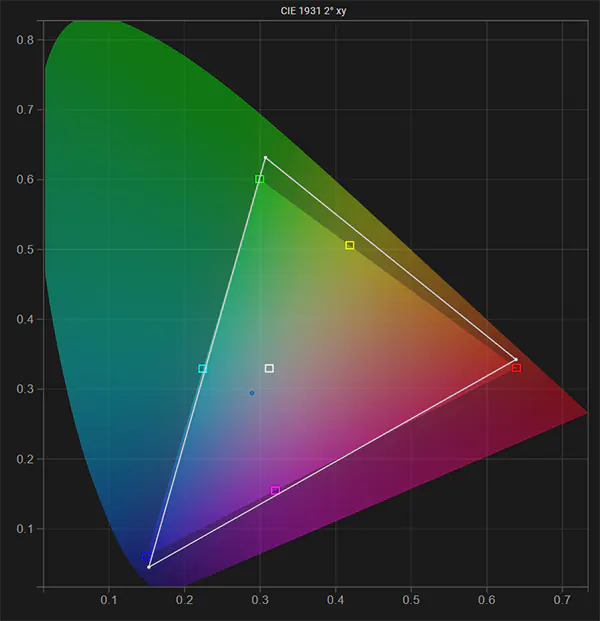
Native Gamut
This is the native gamut (before calibration) of the SmallHD 1703 HDR compared to the Rec 709 color space calibration target. The display does not cover Rec 709 blue on all sides.
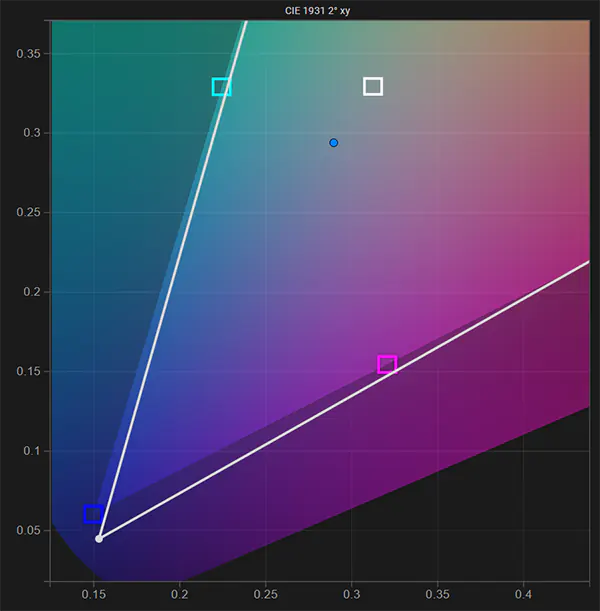
White Point
This is a close-up of the native white point (before calibration) compared to the calibration target of D65, the display white point shows a very strong blue tint. You can also see that R709 blue is not covered on both sides.
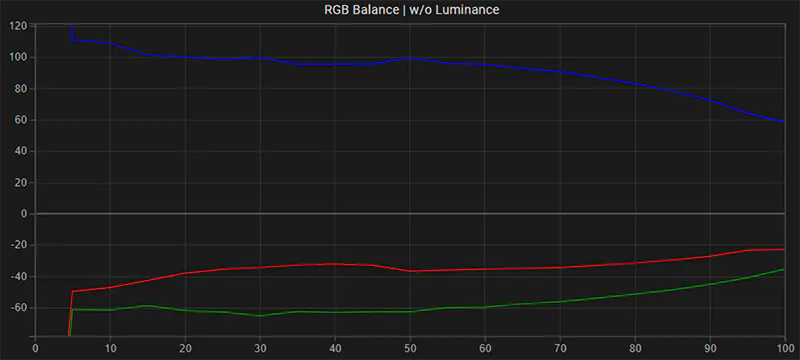
RGB Balance
This is the Greyscale RGB balance before 3D LUT calibration, it has a significant blue tint.
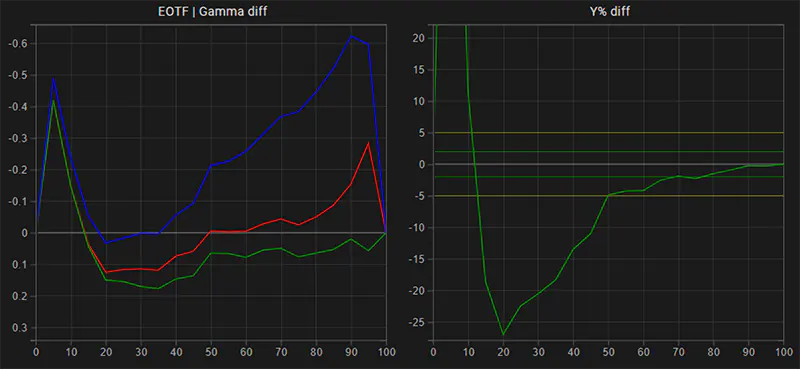
EOTF: Gamma
This is the native gamma and luminance response of the SmallHD 1703 HDR. The reference line is configured for the calibration target G2.4. In its default native state, the display's brightness is non-linar and significantly higher/lower than the calibration target.
Spectrum Analysis
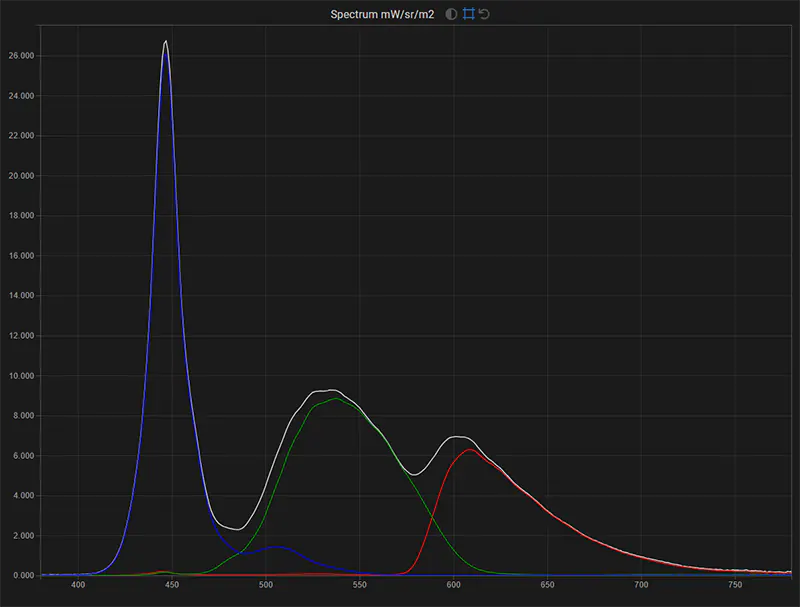
This is the spectrum of the SmallHD 1703 HDR in native gamut for full white, with the red, green and blue primaries spectral output overlaid to identify color channel issues. The R, G, B color channels match the white response well, red channel shows some deviation.
Calibration
After display preparation and configuration, a large display profile is run to create a detailed characterization of the display. From that profile data, a 3D LUT is then generated by DCT and uploaded into the display.
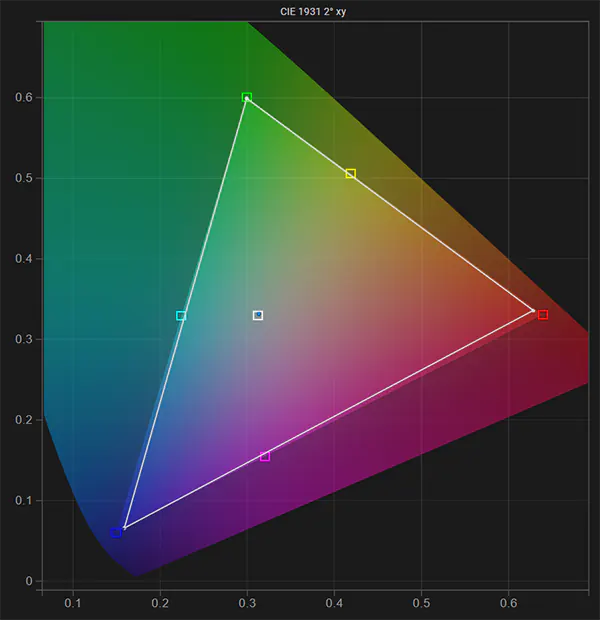
Gamut & White Point (post)
Gamut (post calibration) compared to the Rec 709 D65 target: white, red, green are on target - blue has been corrected to the max capability of the display.
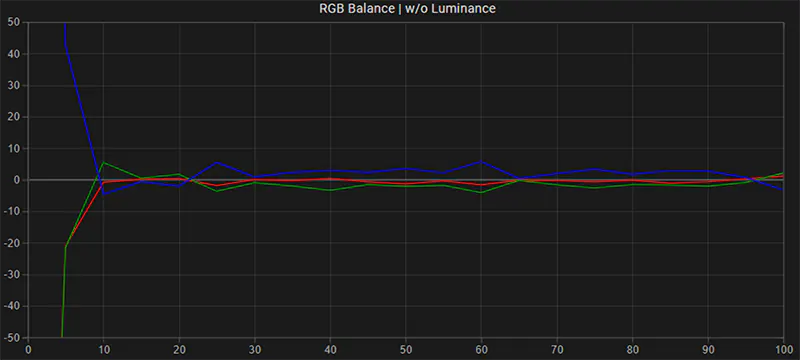
RGB Balance (post)
This is the Greyscale RGB balance post-calibration, a drastic improvement.
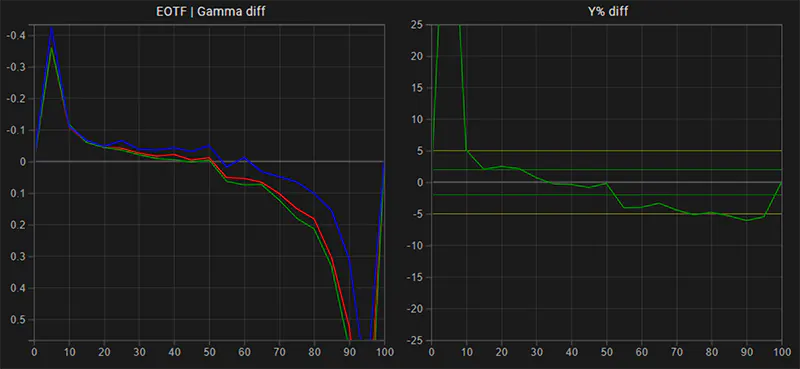
EOTF: Gamma (post)
This is the gamma and luminance response of the SmallHD 1703 HDR after calibration compared to the reference calibration target G2.4. A significant improvement, the display now tracks the reference much better.
Color Error: delta E 2000 (post)
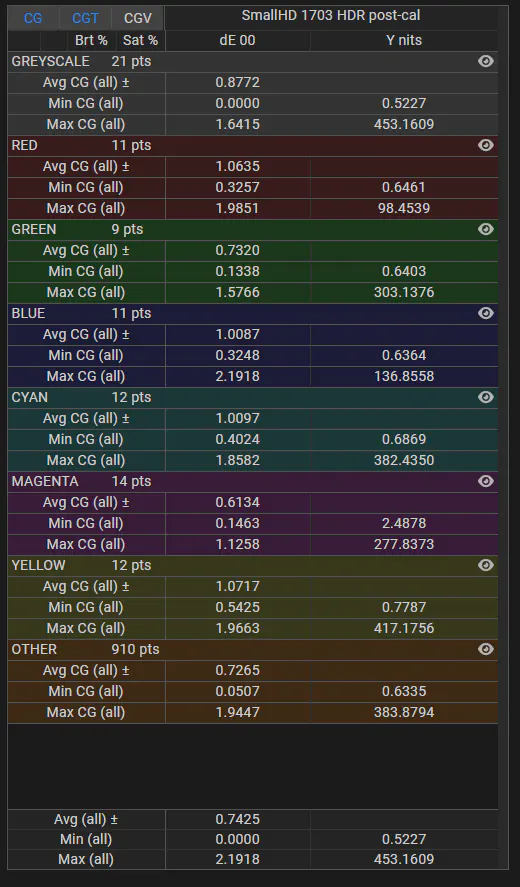
These are the dE 2000 stats post calibration for a 1,000 point stress test validation profile. With an average dE 2000 color error of only 0.74, the SmallHD 1703 HDR now performs exceptionally well given that the JND (just noticeable difference) for human vision is set at a dE 2000 value of 2.3. Blue region performs worst dE wise, this is because (as noted above) the display cannot fully reach R709 blue, it is under-saturated in highly saturated blue colors.
For inquiries regarding display calibration on location in Los Angeles and Southern California or remote worldwide please visit our professional display calibration services page. For inquiries regarding our professional calibration software solutions, please contact us here.
Stay informed about our professional calibration solutions, new display calibration guides and workflows, and exclusive promotional offers - register here for free.
For other Display Calibration Guides & Workflows, please click here.